How to run the change readiness assessment
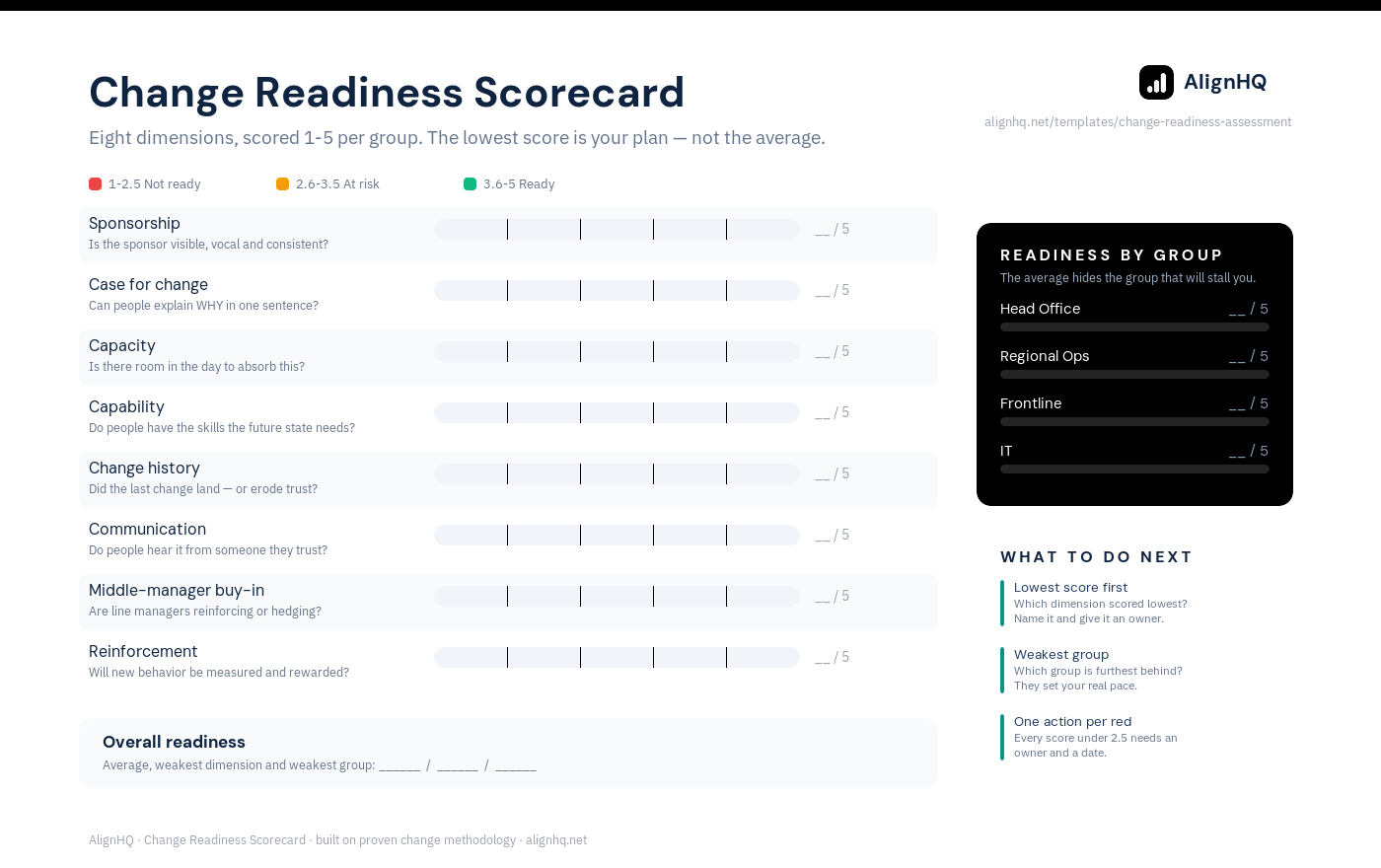
This change readiness assessment template scores eight dimensions for every group your change touches, on a 1–5 scale, and gives you a number per group instead of a general sense of the room. We call the artifact a readiness scorecard, because that's what it does.
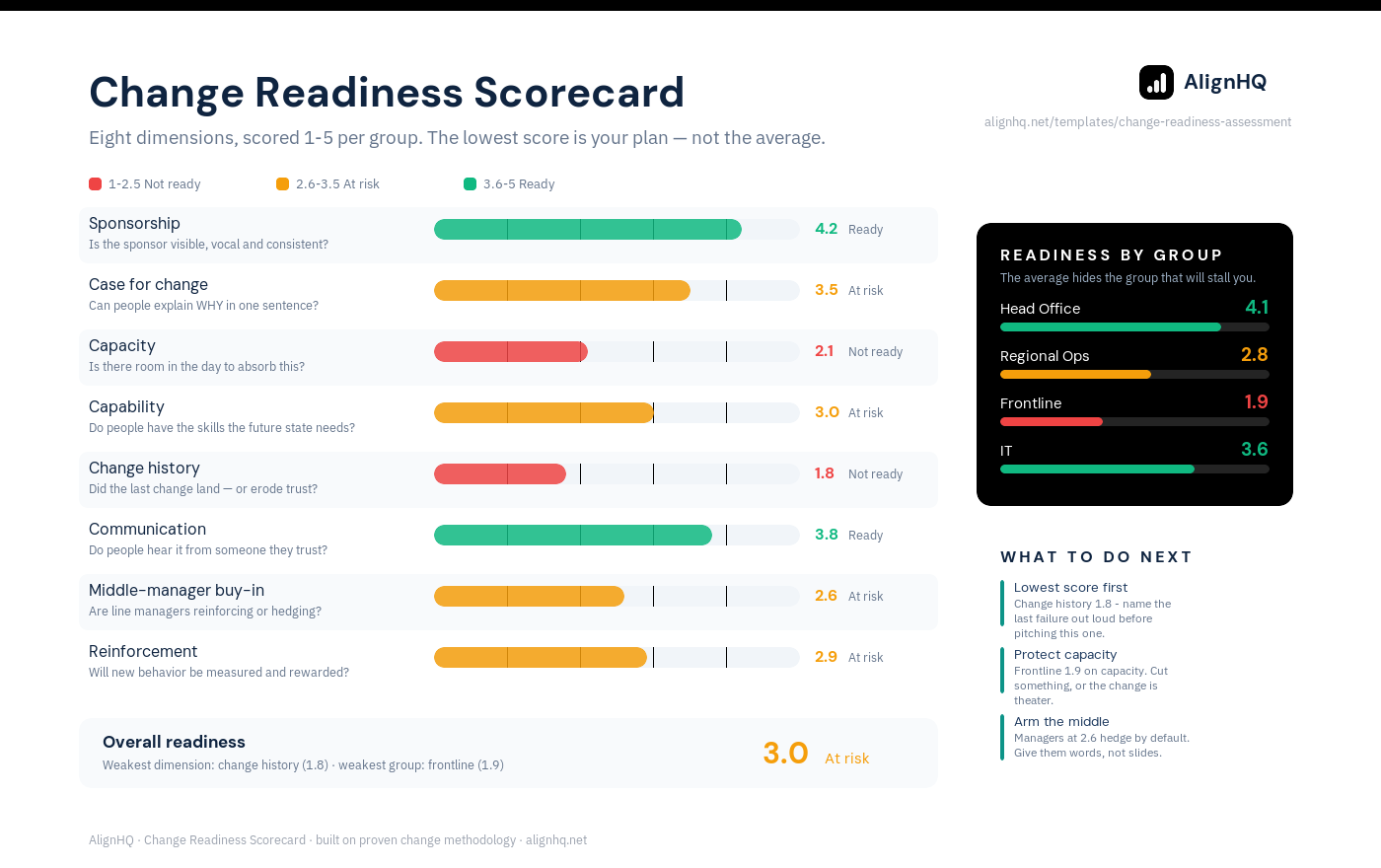
The one rule that makes it work: the lowest score is your plan, not the average. A group at 3.0 overall with capacity at 2.1 is not “at risk, broadly” — it's a capacity problem with seven other numbers hiding it.
Why “are we ready?” is currently answered wrong
In most go/no-go meetings, readiness is settled by whoever speaks with the most confidence. That isn't an assessment, it's a vote — and it reliably favors the person with the most schedule pressure. Then the date holds, the training gets compressed, and the adoption problem shows up six weeks later as “resistance”.
Score by group, never overall
"The business is at 3.0" tells you nothing. "Head office is at 4.1 and frontline is at 1.9" tells you exactly what to do — and those two numbers side by side are the entire argument for scoring this way.
Score low when you're unsure
An optimistic scorecard is worse than no scorecard, because it launders a guess as evidence.
Always attach the gap to the number
A score alone gets argued with. "2.1 on capacity, and the gap is that nothing came off their plate" gets you a sequencing decision, because it names something fixable.
Baseline early, re-score often
Score once at planning, once four weeks out, once one week out. The trend is more useful than any single reading, and a flat trend four weeks out is your earliest reliable warning.
Bring it to steering as a picture
The version that works is the readiness scores next to the stakeholder map on one screen. It moves the meeting from opinion to decisions.
Keep scoring after go-live
Adoption at day 30 and day 60 is the only evidence the change held — and it's the number that gets your change function funded next year.
The eight dimensions, and why each one is on the list
Sponsorship
Visible, vocal, consistent. A sponsor who delegates the message has already told the organization what they think of it.
Case for change
If people can't say why in one sentence, they'll invent a reason — usually a worse one.
Capacity
The most commonly skipped dimension and the most common cause of quiet failure. Nobody adopts anything in a day that's already full.
Capability
Skills the future state needs, not the ones the training plan happens to cover.
Change history
Trust is cumulative and it carries over. This is the score you cannot talk your way out of.
Communication
Reach is not the metric. Whether they hear it from someone they trust is the metric.
Middle-manager buy-in
Line managers hedge by default. Give them words they can say in their own voice, not slides.
Reinforcement
If the old behavior is still what gets measured and rewarded, the change is a suggestion.
Related templates
Use it with the stakeholder mapping template — readiness tells you what to fix, the map tells you who fixes it. The full question bank lives in 20 change readiness assessment questions, and AlignHQ readiness assessments run the whole thing continuously.